
Harrison County Deed Types and Their Uses
The County Clerk in Harrison County records deeds and the land instruments related to them. The Harrison IDX list splits ordinary deeds from deeds of trust, assignments, court-order deeds, tax deeds, transfer-on-death deeds, and mineral or oil-and-gas filings. Those labels mark different legal events. A deed moves an interest in land. A deed of trust secures an obligation instead. A release shows that a recorded claim was later cleared. Before drawing any conclusion, read the instrument. Compare its legal description with the parcel you are tracking. The instrument itself settles what the labels only suggest.
| Instrument label | What the index signals | Why search it |
|---|---|---|
| Deed / deed WV | Recorded conveyance or transfer document | Find parties, date, book/page, and legal description |
| Deed of trust | Recorded security instrument | Locate the original, assignments, and later release |
| Court-order deed | Transfer tied to a court order or case | Pair the instrument with the case record |
| Tax deed / report of sale | Tax-sale or court-sale record family | Check redemption and later orders or releases |
| Transfer-on-death deed | Recorded TOD instrument or revocation | Confirm the filing and any later revocation |
| Mineral deed / easement | Interest may be limited to subsurface or use rights | Read the metes, limits, and interest conveyed |
These search labels describe filings, not the outcome of a title examination. Some instruments cover a narrow interest rather than full surface ownership. A mineral deed can sit right beside ordinary property filings in Harrison County. So can a lease, right-of-way, or easement. Match the legal description against the parcel. Match the instrument type too. Do this before assuming a name hit concerns the right you are studying.
Inside the Harrison County Grantor Index
The Harrison County Land Records Inquiry organizes its holdings into index families. These are Deeds, Liens, Miscellaneous, Estates, Other, Birth, Marriage, and Death. Each family carries its own roles: GRANTOR, GRANTEE, CREDITOR, DEBTOR, DIRECT, REVERSE, GROOM, BRIDE, DECEASED, and INFANT. In an ordinary conveyance, the grantee receives and the grantor gives. The same instrument may be indexed under lender, borrower, decedent, or another role entirely. Pick the role that fits the document.
When the parties are known, search by name first. Then compare the result date, instrument, book and page, page count, subdivision, and cross-date against what you already know. The index exposes columns for Index, Image, Flag, Status, Date, Document, Book Page, Pages, Sub, Name, Cross Date, and Instrument. The Harrison IDX categories and historical book choices appear on the portal's opening screen. That helps separate an index hit from the image or certified instrument behind it. The Harrison County Land Records Inquiry is the entry point for online searching. The county Harrison IDX portal is the official source for those index roles and book selectors. A free index result is not proof that a copy can be downloaded. Confirm image access before counting on one.
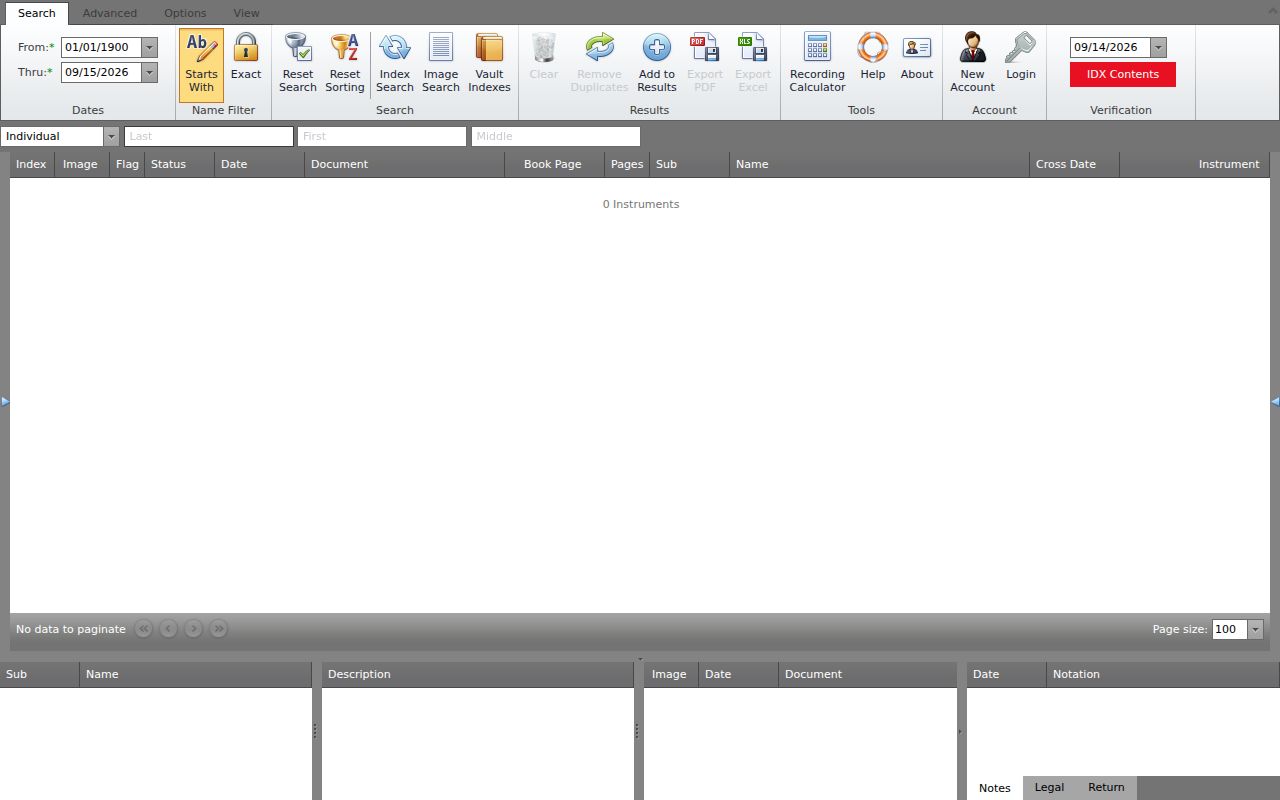
Use the result row to locate a document. Then read the instrument for its actual terms. The County Clerk's public page links the index, the Land Book Index, and the fee schedule. It also posts additional recording information. The counter sits at 229 S. Third Street, Clarksburg, WV 26301, and the listed number is 304-624-8674. Hours run Monday through Friday, 8 a.m. to 4 p.m. Check the current fee schedule first. Then order a plain or certified copy of any Harrison County deed. The clerk page also points to the official access routes for older books. If a web search returns no image, call or visit the counter. Bring the parties, date range, instrument type, and any book or page clue you have. The county Clerk land-record page provides the official index and fee links.
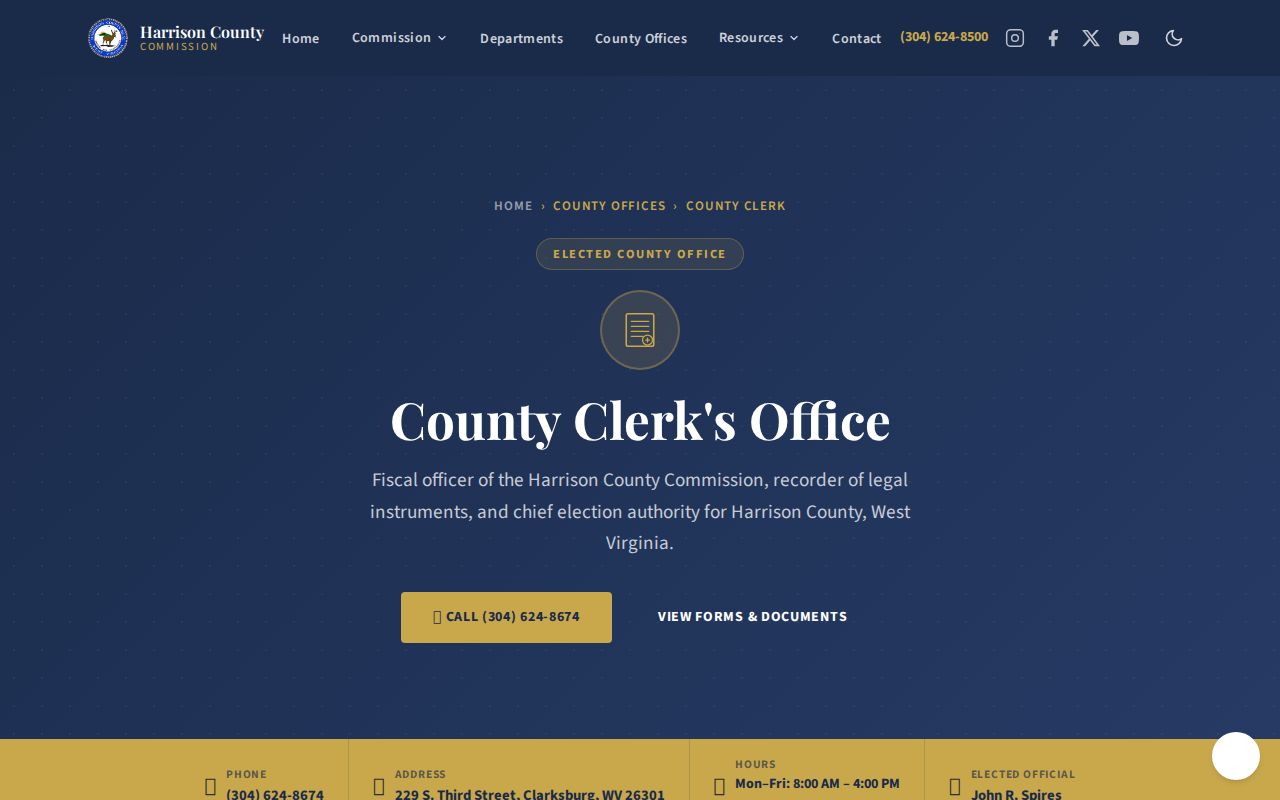
Call the Clerk before relying on an online result. Confirm current copy access and charges. Note: The free index is a finding aid; its role, date, and book/page fields point to an instrument that must be read separately.
Follow the Harrison County Deed Chain
A chain of title traces how a parcel changed hands over time. It works through grantee and grantor roles in the Harrison County deed records. Start with the current assessment name or parcel. Search that owner as grantee. Find the deed that put the property in their name. Read the grantor and the legal description carefully. Then search that grantor as a prior grantee to reach the earlier acquisition. Repeat the process back through the books. When a name changes or the land description shifts, search by description, district, and plat reference as well as by name.
For every entry, note the date. Note the names, the instrument, the book and page, and the exact portion of land conveyed. A same-name person may own a different tract entirely. A single deed can transfer only a mineral share, an easement, or a life estate. Estate orders and court-order deeds move property through a fiduciary or judicial process. So when a chain seems to skip a seller, look for the linked probate or case file in the Harrison County records.
- Find the newest deed with the current owner as grantee.
- Read the instrument for grantor, date, legal description, and book/page.
- Search that grantor as grantee, allowing spelling and entity-name variants.
- Repeat backward, checking each tract and interest rather than only the party names.
- For an older gap, use the land-book or deed-book selectors and ask the Clerk about the volume.
The Harrison County former-owner search focuses on this backward chain and the older book trail. Here, a single deed copy and its recording details stay the focus.
Harrison County Land Books and Older Deeds
Harrison's IDX selectors reach back further than most visitors expect. Land Books span 1796–1910 and 1911–1935. The same index also names deed books, deed-of-trust books, plat cabinets, survey books, road books, judgment books, mechanics-lien books, lis-pendens books, tax-lien books, release books, redemption books, and report-of-sale books. Marriage bonds from 1784–1850 and order books from 1848–1853 round out an index that is a mixed historical archive, not merely a modern real-estate search.
District land-book labels add another layer. They include Clark/Clarksburg, Simpson/Bridgeport, Anmoore, Lumberport, Elk, Nutter Fort, and West Milford. Some entries date from the 1980s and 1990s. The Clerk separately links a Land Book Index numbered 1–93. These older labels matter. A current street address often did not exist in the same form when the entry was written, and the index lists no exact microfilm reels, shelf locations, or imaging cutover year.
Use the local description. Never guess from a city name alone. A subdivision lot may be identified by plat cabinet, lot, and block, while older rural land can rely on metes and bounds or district references. Search both sides of the index. When an entry does not appear under the expected party, run the reverse role, and if no online book exists, ask the Clerk about a counter lookup or a specific volume.
Harrison County Court and Estate Transfers
Harrison IDX covers the probate side of a title. It lists administrator and executor records, affidavits, estate claims and releases, fiduciary orders and reports, small-estate filings, wills and will orders, and circuit-court estate orders. These papers matter when the person who held title has died. Search the decedent first, then the executor or administrator. An order or fiduciary deed can then be matched to the land description. Use the deed index for that match. A case file may be open to the public even where a certified death certificate is restricted.
Harrison County CourtPLUS began taking circuit and family filings on February 13, 2023. It handles filing and case management. The official pages do not expose a stable public party-search route or a full search-field list. Call the Circuit Clerk at 304-624-8640 about inspecting a public docket. For property litigation, line the case number and order up against the recorded deed, lis pendens, report of sale, and release.
The Judiciary offers a Verify an Order tool that works from an alphanumeric reference code. Use it whenever an order reference is in hand. Keep the Clerk counter and the Circuit Clerk straight, too. They are different offices. Note which one holds the instrument and which one holds the court case before asking for copies. A court order and a deed made under that order are separate records.
Note: A probate order, a court docket, and a deed made under the order are separate records reached through different routes.
Harrison County Liens and Deed Releases
A deed search often grows into a lien and release check. Harrison IDX covers deeds of trust, assignments, modifications, releases, mechanics liens, debris-removal liens, judgments, and federal and state tax liens. It also lists fixture filings, UCC, lis pendens, covenants, restrictions, right-of-way, leases, powers of attorney, oil-and-gas releases, termination statements, redemption, and tax deeds. Search the lender as creditor or grantee. Search the borrower as debtor or grantor. Then chase assignments and the later release.
A release indexed without an obvious original can reflect an alternate name, a filing under another role, or a parcel-description difference. A lien index row is not the full claim. A release row is not final proof either. Obtain the image or a certified copy when a purchase, loan, or title decision turns on its terms.
West Virginia's Secretary of State offers a UCC search. It supports debtor, secured-party, and filing-number modes. Each mode answers a different question. Its records can concern business collateral, while county-filed fixture instruments may touch real property. Compare any relevant filing with the County Clerk's local record and the exact collateral description. The image is from the West Virginia UCC search, which is separate from Harrison County's deed index.
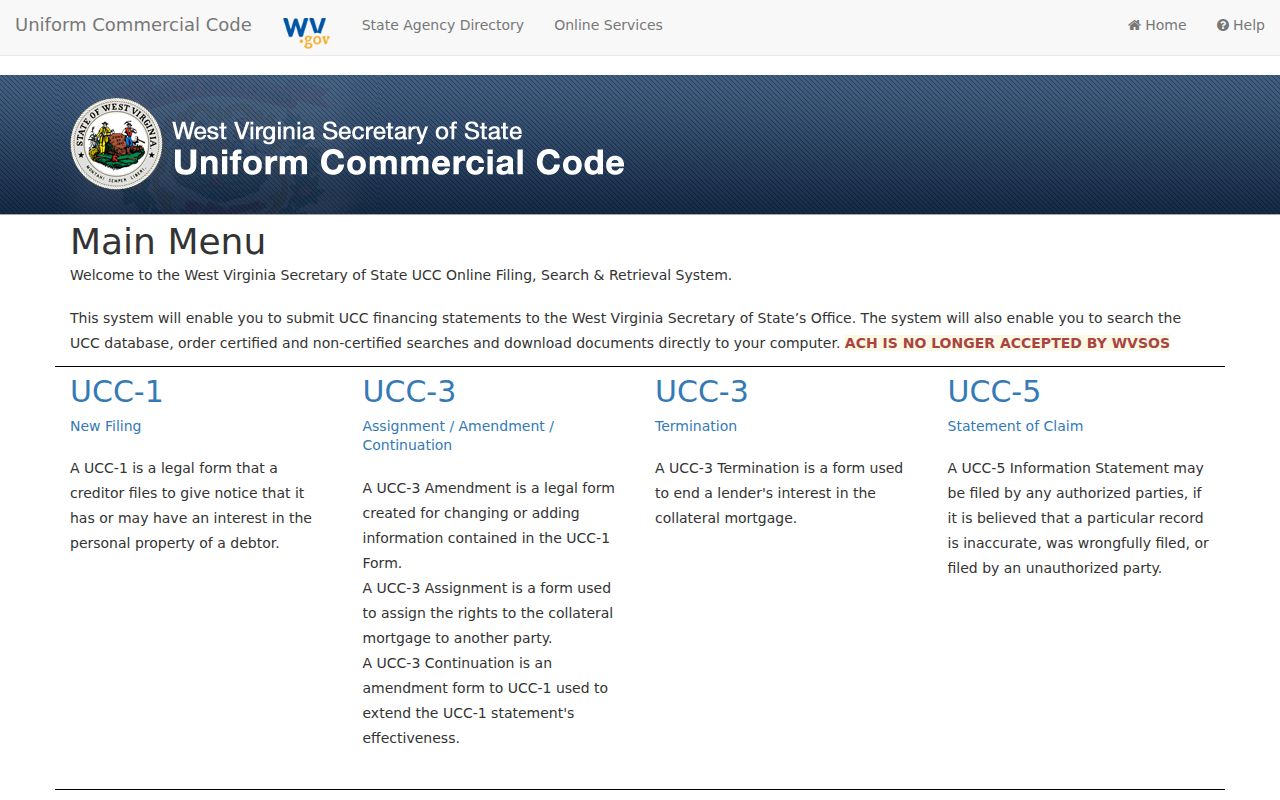
Compare any relevant UCC filing with the county instrument and its specific collateral description. The Sheriff page handles tax collection and FOIA routing. Tax-sale and foreclosure questions also involve court records. The county publishes no verified current delinquent-land list or sale calendar.
Harrison County Deed History Beyond the Portal
The Clerk counter remains the fallback for historic volumes. Give staff the parties, date range, district, book family, and legal description so they can identify the right record. A linked Land Book Index runs 1–93. Exact microfilm reels and shelf locations are not listed.
Waldomore, the Clarksburg-Harrison Public Library local-history collection, holds maps, obituaries, church histories, cemetery lists, yearbooks, and archives. Its HeritageQuest and Fold3 resources can add context to an old owner's name. The State Archives and History Library holds county births and deaths, census, military records, county court material, naturalization, newspapers, and older vital records. These sources help explain a chain. Only the recorded instrument proves a land conveyance.
Ask the Clerk about the current fee schedule for deed images or certified copies. Ask Waldomore about appointment access to fragile archive materials. Keep legal records and historical clues separate. A deed proves the conveyance, and everything else just explains it.
Get a Harrison County Deed Copy
Start with the online index. It helps you identify the deed along with its book, page, and instrument details. The county page links a July 2025 fee schedule. The Clerk's office can confirm the current image and copy procedure and say which historic records are viewable online. A screen result is not a certified copy. For a legal or title purpose, request the form of copy the receiving party requires. Keep the book and page details with your records.
If the online record is missing, give the Clerk the parties, the date range, the instrument type, and the district or legal description. Include any book/page or parcel number. The office sits at 229 S. Third Street in Clarksburg and keeps weekday hours from 8 a.m. to 4 p.m. West Virginia FOIA covers these records. It allows public-body documents at actual reproduction charges, but the Clerk's search staff does not perform title examinations.
- Grantor
- The party conveying or signing over an interest in an instrument.
- Grantee
- The party receiving the interest described in the instrument.
- Book and page
- The recording reference used to locate a filed document.
- Chain of title
- The sequence of recorded transfers that can be traced for a parcel.
Harrison County deed records show what was recorded. They do not capture every unrecorded agreement or every current right in Harrison County. Read the legal description carefully. Verify the parcel on the map. When the stakes call for a title opinion, ask a title professional to evaluate the chain.
Note: Confirm the current fee schedule with the Clerk. Confirm the copy type too before relying on an image for a formal transaction.