
Trace Harrison County Former Owners
A backward chain starts at the newest matching deed. Copy the instrument carefully. Note the date, document type, party names, book and page, subdivision, index role, and cross-date that Harrison County's online index displays. One field deserves extra care. The land description must match the parcel at every step, or the chain may attach the wrong transfer. Work from the recorded instrument itself rather than a remembered date or party.
| Transfer date | Grantor → Grantee | Deed type | Book / page |
|---|---|---|---|
| Read from deed | Record parties in the order shown | Use exact index label | Copy the recording reference |
| Earlier deed date | Search the prior grantor as grantee | Check for a limited interest | Carry the page to the next step |
| Older chain date | Continue by owner and land description | Check court or estate orders | Switch to an older book if needed |
The County Clerk indexes parties by role. Roles include GRANTOR, GRANTEE, DIRECT, REVERSE, CREDITOR, and DEBTOR. Search the current owner as grantee. The grantor on that deed becomes the candidate prior owner, so search that name as grantee next, allowing for name variations, entity forms, and fiduciary roles. The legal description is the guardrail when two people share a name or a parcel has been divided.
Move Back Through Harrison County Names
Each deed can point to an earlier one. A name-only search can break the chain. Read what the document actually conveys. It may cover the whole surface parcel. Or it may convey only a mineral interest, an easement, or another limited right. Note the instrument, date, recording reference, and names, then confirm the next instrument covers the same land. If a subdivision name or parcel description changes, search those words along with the parties.
Harrison IDX keeps separate index families for Deeds, Liens, Miscellaneous, Estates, Other, Birth, Marriage, and Death. Not every owner-name hit is a conveyance. An estate transfer may appear as an administrator or executor entry, will order, small-estate record, affidavit, or court-order deed. Foreclosures and tax sales show up as reports of sale, redemptions, or tax deeds. Pick the category that fits the event.
- Start with the newest deed that matches the present parcel description.
- Record its grantor, grantee, date, instrument type, and book/page.
- Search the grantor as the earlier grantee, including entity or estate variants.
- Confirm each next document transfers the same land or a clearly related part.
- When the online book ends, ask the Clerk for the older book or index route.
The Harrison County deed-record search covers the index roles and the full copy path. This backward chain serves a different purpose. It targets earlier owners and time depth. Ordering a single certified copy is a separate errand. It differs from walking a parcel's full ownership history.
Note: The legal description anchors the chain when names repeat or the parcel changes shape in the index.
Harrison County Land Records Before 1936
Harrison County's records reach back well before modern indexing. The Harrison IDX menu names Land Books covering 1796–1910 and 1911–1935. That is two centuries of land records. It also lists deed, deed-of-trust, judgment, lis-pendens, and mechanics-lien books. Tax-lien, plat-cabinet, survey, road, and will books are there too. Release, redemption, and report-of-sale books round out the list. Marriage bonds from 1784–1850 and order books from 1848–1853 show the selector reaches beyond deeds. The Clerk page separately links a Land Book Index numbered 1–93.
These labels are gold for local history. Each label names a book family and date range. They do not promise scans. A label does not guarantee that every page is digitized. Nor does it promise the image is available to every visitor. The portal is silent there. It publishes no image cutoff, microfilm reel numbers, or vault shelf locations. The portal does not always expose the right volume. Ask the Clerk which physical or microfilm volume holds the year and district.
Older properties predate modern street names. Districts changed too. Do not force a current address into an old search. Follow the district and legal-description language instead. Historic land books may use a district label, a previous owner, or a survey reference. The chain may be uncertain. Then search both direct and reverse roles. Test the parcel against any recorded plat or survey.
The index menu displays those historical book choices directly. Its date spans and separate book categories can help. They can guide a call or a counter request to the Clerk.
The original Harrison IDX index is the source for these historic book and role choices.
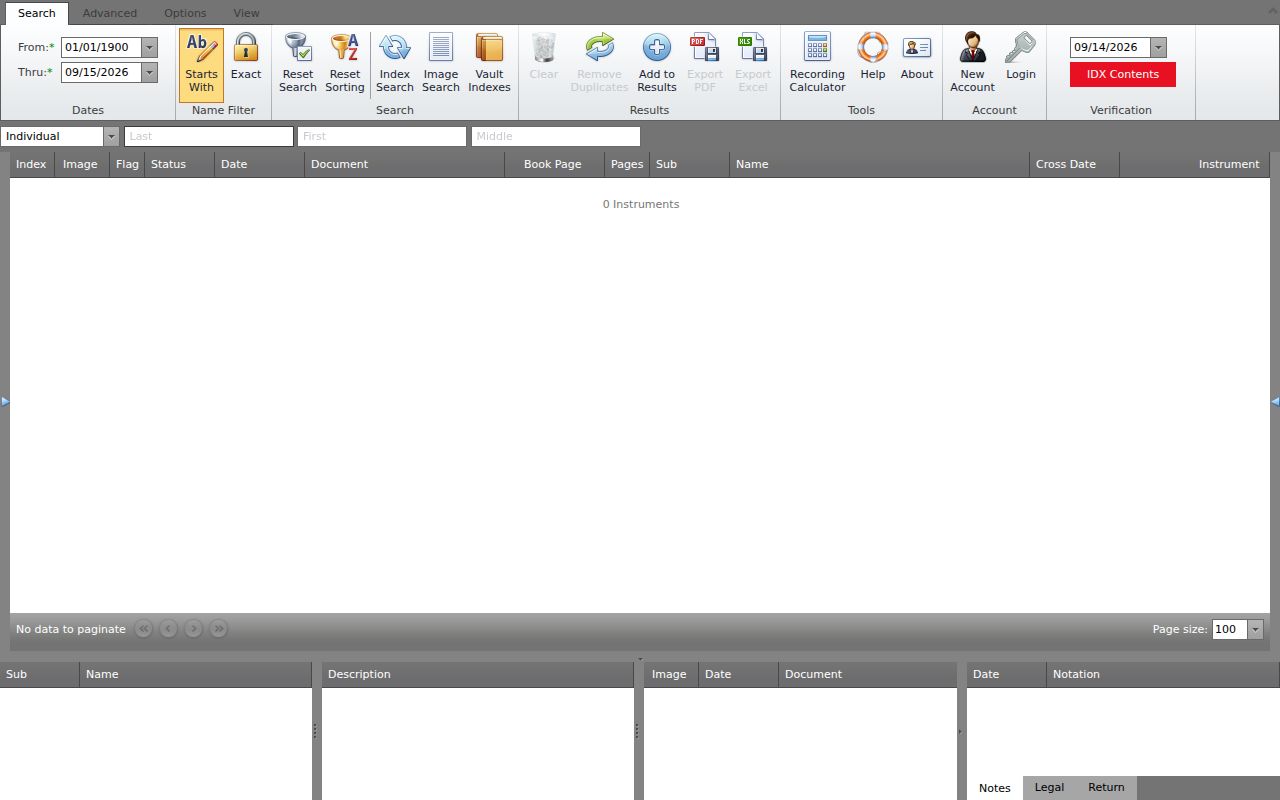
The instrument, not the selection, confirms the transfer.
District Books for Harrison County Property History
District labels rescue a stalled search. The portal identifies district books for Clark/Clarksburg, Simpson/Bridgeport, Anmoore, Lumberport, Elk, Nutter Fort, and West Milford, with examples from 1986–1997. Those categories can link a parcel to a historic tax map or local land book. A district is a filing label. It is not an exact present-day municipal boundary.
Bridgeport offers a good example. Simpson district books work as a cross-reference for a Bridgeport parcel. The index even lists an “X LAND BOOK – SIMPSON DIST – BRIDGEPORT – 1996” entry. For Clarksburg, pair Clark/Clarksburg with the deed description. A current neighborhood name may not match the book label. Compare the township or district, map, parcel, lot, block, and recorded instrument as a set.
A plat or survey can bridge old and new. It joins an older tract to a modern tax parcel. The Clerk index includes large and small plats, plat cabinets, and survey books. Never infer a plat from a familiar label.
Harrison County Estate Filings Split Owner Chains
A death in the family can shift land without anything resembling a sale. Estates leave paper trails. Harrison County routes estate transfers through the Clerk. Its guides cover small-estate affidavits, appointment waivers for an administrator or executor, and ancillary administration of West Virginia real estate. The IDX list adds wills, will orders, fiduciary reports, estate claims, and transfer-on-death deeds with revocations. The decedent, executor, administrator, and any later grantee can each surface in the deed records.
A probate order and its deed are two links in one chain. The order shows who held authority. The deed moves the land. Get both. Certified death certificates come from State Vital Registration, birth records stay closed until at least 100 years old, and the exact release rules for death and marriage records rest with that state office.
Suppose the deed trail turns up an estate name. Copy the case number and any fiduciary details. The Clerk or the Circuit Clerk can point to the file. Harrison CourtPLUS opened circuit and family e-filing in February 2023. The Circuit Clerk can explain file inspection in person.
Note: An estate order may authorize a transfer, while a separate deed records the conveyance itself.
Harrison County Mineral Deeds Are Limited Transfers
Not every deed conveys full ownership. One instrument can reserve or grant minerals, an easement, a right-of-way, a lease, a life estate, or another limited interest. Harrison County tracks these on two paths. The Assessor keeps a separate mineral account, while the Clerk's index lists mineral and oil-and-gas instruments alongside surface deeds. The tax owner of record can differ from the mineral holder. Neither record duplicates the other.
Read the granting language closely. Match it against the legal description and against the question you are actually asking. A release of one instrument clears nothing else, and a mineral record may cover only part of the land. A title question calls for the recorded documents themselves, reviewed together by a qualified professional. Not every indexed name was a former fee-simple owner.
Harrison County Property Archives Add Context
Waldomore hides its treasure upstairs. The second-floor Local History and Genealogy Collection holds maps, cemetery lists, obituaries, church histories, yearbooks, photographs, diaries, letters, and local archives. Visiting hours run Monday through Friday. The room opens at 10 a.m. and closes at 6 p.m. Archive materials require an appointment. Staff answer at 304-627-2236 extension 220 or waldomore@clarksburglibrary.org. The library's databases page also points to HeritageQuest, Fold3 Library Edition, and the Harrison County Historical Society.
These materials tie a former owner to a household, a place, or a family event. Clarksburg directories start in 1905. They run through 1960, with gaps. Bridgeport keeps early and mid-century runs as well. A directory gives an address-to-occupant clue, never a title record, so pair it with the deed, the probate file, and the tax account.
Waldomore's own collection page describes the 1842 house and its research room, though fragile materials require advance contact rather than an unscheduled visit.
Treat archive finds as clues. The parcel history itself lives in recorded deeds and estate files. When an online owner chain stops, request the specific volume from the Clerk. Keep each source separate in your notes. Directory, obituary, assessment, probate order, deed, and plat each support a different link in the story.
How Far Back Harrison County Records Go
The land-book menu reaches back to 1796. That figure describes the index, not a verified image range, and the county itself began in 1784 while the portal's earliest listed book is later. The portal publishes no digitization cutoff, sample deed image, or microfilm guide, so ask the Clerk which records survive for a given year and how to inspect or copy them.
Old documents talk strangely. Expect older tract descriptions, district names that no longer exist, and spellings that wander. Search a broad date range. Test both direct and reverse index roles, and compare any survey or plat references along the way. An online search may not reach every predecessor. A missing name proves nothing. Owners may still exist before the first result.
Start with the newest Assessor record and the latest recorded deed. Then work backward. For a formal title chain, a title professional can spot exceptions, gaps, and instruments a basic name search misses.
Note: A visible book range does not prove that every Harrison County page is scanned or searchable online.